
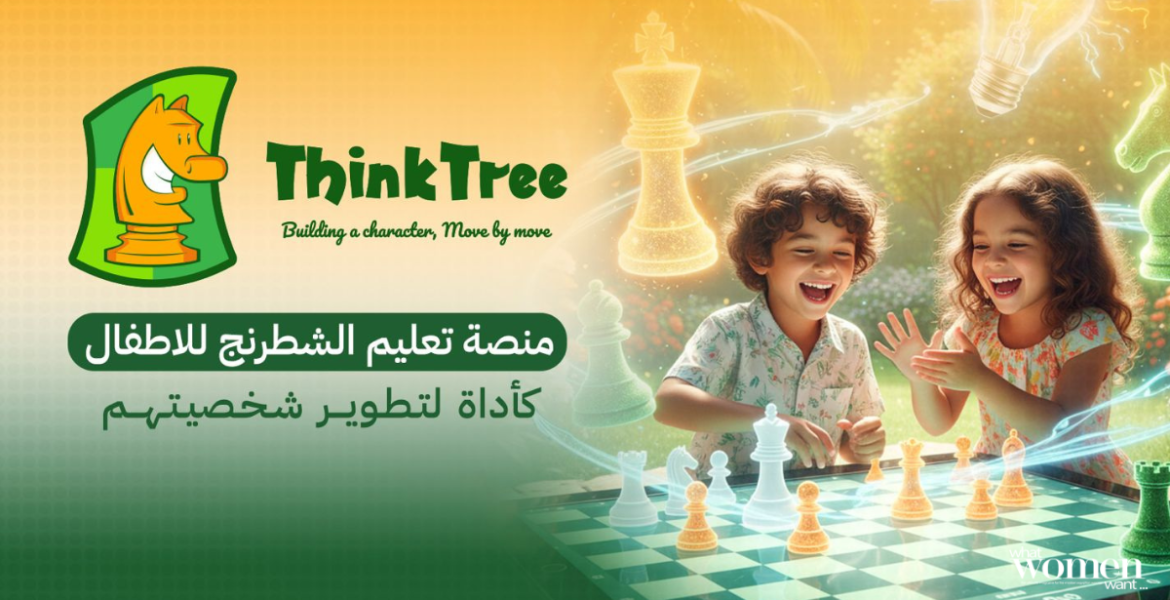
In an era defined by doom-scrolling, old board game is making a modern comeback as a powerful educational tool. More Than a Game: How Chess is Shaping the Next Generation’s Minds. Chess is no longer viewed just as a hobby for the elite. It is a mental lab where children learn to navigate life’s hardships. This is the core philosophy of ThinkTree, an Egyptian startup founded by Ahmed El Adly. As It’s an online platform transforming chess from a game into a dynamic system for character building.
The Spark: A Brother’s Transformation
The idea for ThinkTree wasn’t born from a business plan but from a family observation. After teaching his younger brother to play, Ahmed noticed a profound change; he witnessed a “massive transformation” in his brother’s personality. Accordingly, he became more organized, confident, and decisive.
“I felt his mind became more organized, and I decided, “Let’s start with children to see the development that occurs,” and it actually happened.
He realized that the game offered a unique “tree” of thinking, one that matures and grows the more a child engages with it.
The “ThinkTree” Philosophy: Why Chess?
The game serves as a “let-out zone” for several critical life skills. First of all, every move in chess has a consequence. Children learn to ask, “If I do this, how will my opponent respond?” This habit of forward-thinking is the foundation of real-world problem solving.
Furthermore, while modern media trains children to crave 30-second content of entertainment, a chess match requires them to sit, calculate, and focus for an hour. In the ThinkTree curriculum, losing is not a failure; it is a lesson. Ahmed emphasizes that the goal isn’t just to “win” but to learn from mistakes and understand why a move failed.
“Our goal isn’t to create a champion; our goal is to develop their personalities and evolve their memory and logical thinking.” Ahmed noted.
Teaching Life through Logic
For many, chess is an intimidating game of strategy. At ThinkTree, it is a “play hour.” The methodology focuses on three core pillars as children learn to slow down. “They become more organized in their thinking and more focused,” Ahmed explains, noting how the approach counters the “fast world” of reels and short-form content.
Moreover, the goal isn’t to create a world champion but a resilient individual. “We’re not focused on winning. even the assessment might be for the student to lose five matches to make them learn from each mistake.” Ahmed believes in the inclusivity of the game: “The beauty of chess is that anyone can play. It isn’t limited by age or gender.”
The Next Move
For Ahmed El Adly, the ultimate “checkmate” didn’t happen on a chessboard but on the set of Shark Tank Egypt. The sharks appraised the philosophy he implemented in ThinkTree with the core value of developing the children’s personality and characteristics.
“We care deeply about the experience itself,” Ahmed said. “If the experience is good, the child is the one who will insist to their parents that they renew and stay with us.”
More Than a Game: Chess is Shaping the Next Generation’s Minds. ThinkTree’s “shout-out” to the world is clear: art and strategy are the ultimate tools for growth. With plans for a unified mobile app and a tech ecosystem. Ahmed envisions a future where every child in the Arab world has a platform to train, play, and, most importantly, grow.