
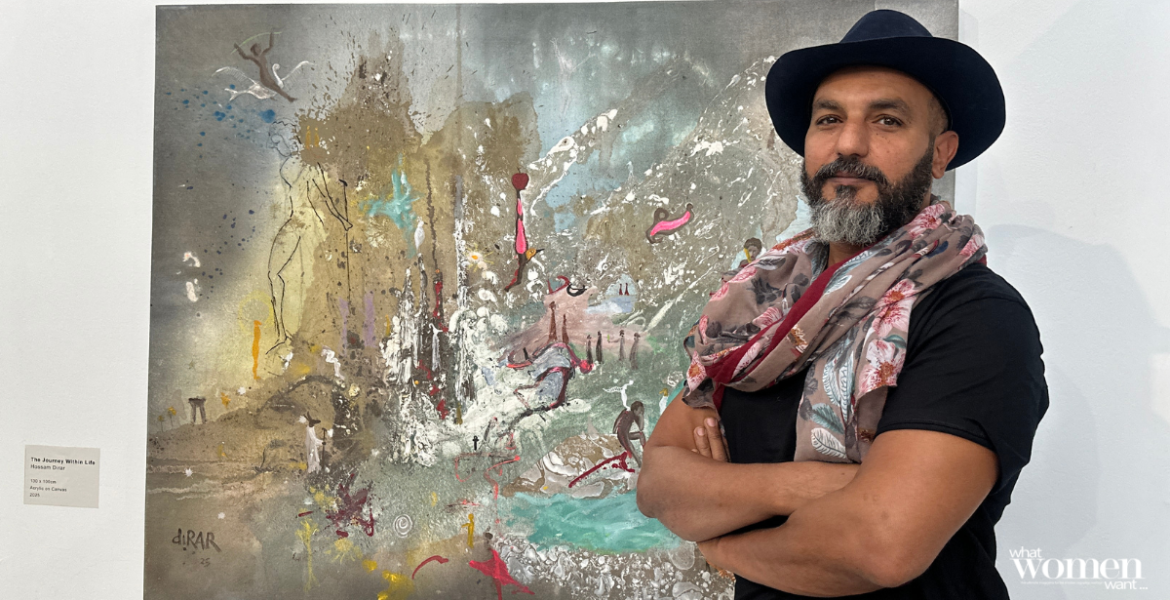
To step into the world of Hossam Dirar is to abandon the linear perception of time. Coming Forth Into Daylight: The Conceptual Surrealism of Hossam Dirar. In his latest exhibition, the Cairo-born artist invites the viewer on a journey that starts with shadow of personal trauma and concludes with conscious awareness clarity.
For Dirar, art is no longer a static portrait of history; it is a dynamic, surrealist language. It’s designed to bridge the gap between the ancient roots of the Egyptian soul and the complexities of modern existence. Throughout the exhibition, it’s a movement toward light, higher consciousness, and inner awareness in search of a deeper understanding of life.
You can still catch the exhibition until the 28th of April at Rawabet art space.
From Persona to Narrative
Hossam Dirar’s career has been one of consistent evolution. For years, he earned wide recognition for mastering the static majesty of Egypt’s past, particularly in his iconic portraits of queens like Nefertiti and Cleopatra. Dirar’s works concentrated on the individual, the character, the gaze, and the unique history they embodied.
However, over the last five years, Dirar has undergone a radical transformation.
“I began working on the idea of creating a complex story, not just a single character,” Dirar explains.
His new compositions function like dreamscapes. Ancient symbols such as Anubis, Thoth, and Hathor are no longer presented as academic artifacts or historical icons. Instead, they are active participants in a surrealist drama. By blending these classical figures with dream-like environments and modern motifs, such as the examples portrayed in his work, the apple of Eve or contemporary architectural shapes, Dirar forces the viewer to move beyond recognition. He is not asking us to identify a painting; he is asking us to interpret it.
The Architecture of the Sacred
One of the most important aspects of Dirar’s evolution is his structural approach to the canvas. In his search for a new visual vocabulary, he has adopted the tree as a primary architectural motif. With its roots grounding the composition and its branches framing the narrative, the tree becomes a metaphor for the human experience, a structure of life itself.
“I took the woman’s womb as my fundamental element, and I began grounding it with roots like a tree. As the child emerges, he learns from Thoth, the symbol of wisdom, who intuitively imparts all the initial messages. The composition as a whole plays on the idea of the waves within the tree, which represent the waves of our own lives, carrying us from one stage to the next,” Hossam reflects.
Dirar draws a profound connection between this structure and the “womb,” which he identifies as the ultimate origin of all creation. By intertwining the biological womb with the symbolic tree, he creates a visual language that connects the individual human experience to the ancient concepts of growth, wisdom, and lineage.
The Technique of Transparency: Layers of Light
Technically, Dirar’s work has stripped itself down to a fundamental essential: the interplay of light and dark. In his recent monochrome works, he has moved away from a broad spectrum of colors to focus entirely on the potential of black and white.
“I don’t need to work with many colors. For me, black and white are light and darkness,” he says.
His technique involves a rigorous process of building “layers upon layers.” Because each layer is transparent, the painting develops a physical and conceptual depth that mimics the transparency of existence itself, where some memories fade, others remain translucent, and some emerge into the light.
“The more layers I add, the more depth it imparts to the painting, and I always link this process to life itself. Even though the painting lacks a specific color palette, it is filled with movement; you find some elements appearing rapid and dynamic, while others remain stable,” Hossam notes.
Even in the absence of color, his paintings are defined by intense movement. Whether it is a horse fleeing into the shadows or a figure standing in the light, Dirar uses contrast to transform the canvas into a cinematic stage. He treats the canvas as a lab of light, where the “shadows” represent our past traumas and the “light” represents the inner illumination we strive to reach.
Rediscovering the “Sacred” in the Modern Age
Central to Dirar’s philosophy is a rejection of the superficial view of Egyptian heritage. To him, the symbols of his ancestors are not merely decorative motifs; they are the vocabulary of his own identity.
“One of the important things I thought about is the idea of the “sacred”. What is sacred for us? They had family as something sacred. Marriage as something sacred. The relationship with children is sacred.” Hossam explains the ideology behind sacred.
In a world where he feels the concept of the “sacred,” the sanctity of family, marriage, and the spirit, has been eroded or negotiable. Dirar looks to the ancient world to find definitions that still ring true. His work asks us to consider what it means to be connected to the divine, and to our environment
The Visibility of the Invisible
“I will make people see things that their eyes usually don’t see,” Dirar reflects.
His exhibition Coming Forth Into the Daylight is not a literal recreation of the ancient funerary texts of the Book of the Dead. Instead, it is a conceptual exploration of consciousness. It is about leaving the “darkness” of the shadow self and moving into the “light” of awareness.
“That’s why I named the exhibition Coming Forth to the Daylight. You leave all the darkness and go to the light,”
Hossam explained that this black and white collection explores the coexistence of light and darkness
“Even in our personalities, there is our internal shadow that comes from memories and traumas, and we have the light that is already inside us.”
Coming Forth Into Daylight: The Conceptual Surrealism of Hossam Dirar. In his world paints, everything is possible. A fish does not need the sea; a figure can morph into a bird. By capturing these manifestations and distilling them to their essential forms, he creates a space where intuition replaces logic. For the viewer, the beauty of this abstract surrealism lies in the freedom it grants us. His work invites us to move beyond the search for a definitive meaning and, instead, to discover our own images and truths within its complex, haunting, and deeply human layers.